what can be done to save our ocean from the garbage patch in the pacific ocean?
Article updated on eight Feb 2022 by Ben Pilkington
Millions of tons of plastic make their way into the world'south oceans every year, which are currently polluted with approximately 5 trillion pieces of plastic waste. Most are carried into the oceans from rivers, and, once in the sea, some get captured in currents that carry them to ane of v ocean gyres, or "garbage patches."
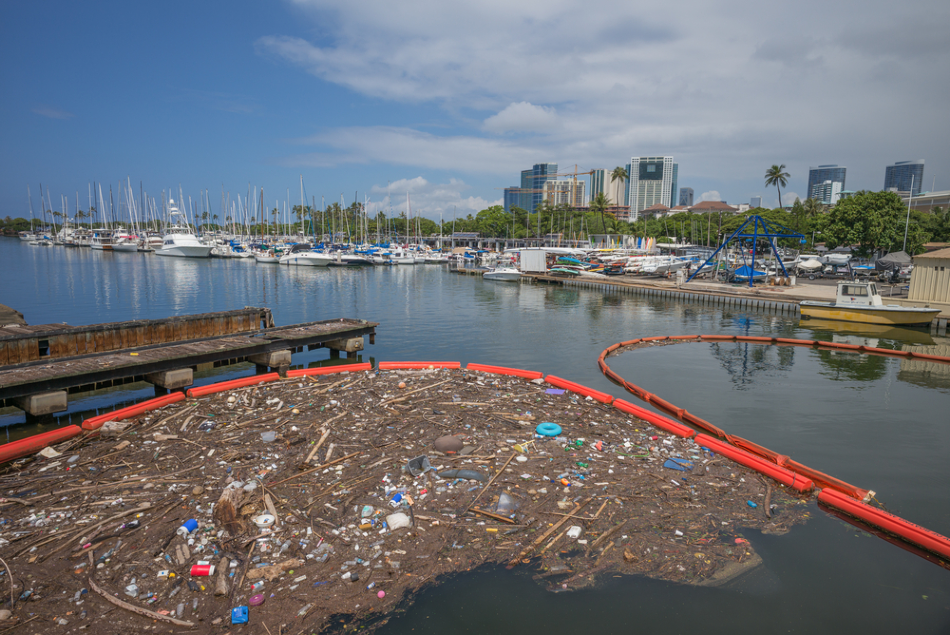
Prototype Credit: Theodore Trimmer/Shutterstock.com
What is the Slap-up Pacific Garbage Patch?
The largest of these patches is situated between Hawaii and California and is known as the "The Peachy Pacific Garbage Patch." Also referred to as the Pacific Trash Vortex, the coil spans more than 617,000 square miles, more than than twice the size of France.
Most of the plastic is "ghost gear," abandoned fishing nets, and ropes that often strangle or suffocate animals. Other discarded plastic is eaten by animals that frequently die from starvation because they cannot feed properly.
Upwards to ninety% of plastic produced never gets recycled, and because it tin can take hundreds of years to dethrone, researchers think almost every single piece ever manufactured withal exists today in some class, somewhere.
Without activeness being taken to both remove existing plastic in the body of water and interrupt its inflow from rivers, this pollution will go on to take a devastating outcome on wildlife, ecosystems, and, somewhen, human health.
The Solution to the Not bad Pacific Garbage Patch: The Ocean Cleanup Projection
Founded past entrepreneur Boyan Slat in 2013, The Ocean Cleanup is a non-turn a profit system that has been carrying out what it refers to equally "the largest clean-upward in history". This ambitious, two-pronged projection rolled out advanced technological systems at a scale big plenty to remove half of the plastic in the Great Pacific Garbage Patch (around xl,000 metric tons) over five years. They also worked to interrupt the menstruum of plastic at the river source.
The nonprofit says that with enough fleets of systems deployed in every ocean gyre and with the inflow from rivers reduced, it should be able to make clean upwards 90% of all plastic ocean waste past 2040.
The first stage of the project, cleaning the oceans, was idea up by Slat following a holiday in Greece where he saw more plastic than fish while diving. Subsequently learning more most the problem, he started working on a passive clean-up solution at university and eventually founded The Ocean Cleanup.
Slat has designed a passive bounding main-based cleaning system consisting of a long plastic floating tube, which is approximately the length of a football pitch suspended at the water'due south surface. A nylon skirt extending beneath that guides debris into a retention organisation that concentrates the plastic for collection.
Interceptor: The River Cleaning Solution
Research conducted by the Body of water Cleanup established that 1,000 rivers are responsible for around 80% of river-borne plastic waste in the ocean. The organization plans to accept tackled all of them by 2025.
The second part of the project involves a clean-up technology called the Interceptor, which is an automated droppings filtration and extraction system that can operate in about of the world'southward height polluting rivers.
Slat said: "Combining our ocean clean-up technology with the Interceptor, the solutions now exist to address both sides of the equation."
Harnessing Natural Forces to Clean the Great Pacific Garbage Patch
Actively cleaning the Peachy Pacific Garbage Patch using traditional methods such every bit nets and vessels would exist too energy-intensive, toll billions, and would take thousands of years to complete.
With the Ocean Cleanup's passive system, which is guided through garbage patches by natural forces (current of air, waves, and current), half of the plastic droppings could exist removed in just five years at a fraction of the price. This passive harnessing of natural forces also increases the system's power to withstand hazardous body of water environments.
When Slat beginning proposed the pattern, some scientists were skeptical about its feasibility. Nonetheless, Slat left university to pursue the project, and The Ocean Cleanup raised millions through a crowdfunding campaign and millions more from other investors, including Salesforce CEO Marc Benioff.
How Does the Body of water Cleanup Project'due south Engineering Piece of work?
The developed engineering science creates a drag that allows swirling plastic to be captured and full-bodied for effective removal from the bounding main. Huge anchors floating hundreds of anxiety below steady the system while it moves more slowly than the plastic, scooping information technology up from behind.
The commencement device, System 001, was made upwards of a 2000 ft floater tube, a 9.viii ft-broad skirt, and incorporated solar-powered GPS, cameras, and lanterns. It was deployed in San Francisco in September 2018 to gather plastic from the Great Pacific Garbage Patch. However, the system failed to retain plastic and was returned to shore in January 2019. Later several design modifications past the engineering squad, an upgraded version, Organisation 001/B, was deployed in June 2019.
On October two, 2019, the Ocean Cleanup announced that system 001/B had passively captured plastic in the Great Pacific Garbage Patch, proving the applied science's foundational concept and meaning the team could start work on their side by side upgrade, System 002.
The engineering team has designed System 002 as a more extensive, full-scale operation with a focus on autonomous navigation, long-term plastic retention, and durability at sea.
On December 2, 2019, in Vancouver, Canada, the Ocean Cleanup presented the starting time plastic captured and collected with the passive system while information technology was self-contained in the Great Pacific Garbage Patch.
Intercepting River Plastic Guided by Natural Currents
Too equally capturing the trillions of tons of sea plastic already out at that place, Slat aims to close the tap on the one,000 highest polluting rivers that are feeding 80% of all river-borne plastic into the oceans. By collaborating with regime leaders and private corporations, the Ocean Cleanup plans to take tackled all these rivers past 2025.
On Oct 26, 2019, in Rotterdam, Netherlands, Slat unveiled The Interceptor, the earth's first scalable solution to interrupting the river-to-ocean plastic flow that can be deployed across the globe. This system can be strategically placed to intercept the main catamenia of debris while allowing boats to pass and non impede wildlife movement.
It can excerpt 50,000 kg of waste per day and even 100,000 kg per day under optimal conditions. All electronics incorporated into the organization, including a conveyor belt, shuttle, lights, and sensors, are 100% solar powered.
So far, the Ocean Cleanup has built iv of the systems. One has been deployed in Jakarta, Indonesia, ane in Klang, Malaysia, and a tertiary is waiting to exist installed in CanTho, Vietnam. A fourth is due to be deployed in Santo Domingo, Dominican Democracy.
Thailand has as well agreed to the Interceptor being deployed in a river most Bangkok, and agreements with other governments are budgeted completion, including one in Los Angeles Canton, California.
New Interceptor Solutions To Clean More Rivers | The Ocean Cleanup
Video Credit: The Ocean Cleanup/YouTube.com
How Does the River Cleaner Work?
River waste material flowing with the natural electric current enters the Interceptor and is carried onto a conveyor belt that delivers the droppings to a shuttle. Guided by sensors, the waste material is distributed by the shuttle into one of half dozen dumpsters, which are each filled until they reach full chapters (up to 50 m3). Once the barge is almost full, an automated text alerts locals, who bring it to shore, empty the droppings and send it to local waste management centers, before returning the barge to the Interceptor.
For more information about how the river cleaner works, watch the video below:
Turning Marine Plastic Waste into "Cute, Sustainable Products"
From the get-go, The Ocean Cleanup had planned to recycle the marine plastic it collects, and on December 12, 2019, after presenting the start plastic captured from the Dandy Pacific Garbage Patch, Slat also announced the plan to turn it into "cute, sustainable products."
The Ocean Cleanup was designed to turn the marine plastic waste it collects into sustainable products that could be sold to fund the continuation of its clean-ups. Subsequently announcing the first capture of plastic from the Great Pacific Garbage Patch, Slat announced his plans to launch the premier products in September 2020.
Slat said:
Welcoming the offset catch of plastic on country is the moment we have been looking forward to for years. I believe we tin can use this trash to plow a trouble into a solution by transforming this unique cloth into a beautiful production.
The organization plans to launch its premier plastic production in September 2020, and use 100% of all proceeds to contribute to the continuation of The Ocean Cleanup projection.
Slat said: "As most people will never go to the Great Pacific Garbage Patch, through these products, we aim to give everyone the opportunity to accept function in the clean-up."
The Ocean Cleanup Project in Numbers
The Ocean Cleanup Project works with a 3rd-party evaluation and validation partner to provide authentic and reliable figures to measure out its impact on the body of water plastic problem. DNV, the system that developed the ocean plastic standard used by nonprofits, government, and researchers to define plastic pollution, is well suited to provide expert impartial validation of the Ocean Cleanup Project'southward impact.
DNV gets its information by trawling through the Bounding main Cleanup Project's documents, data from remote sensing devices, offloading records from sea catches, receipts from waste product collectors or waste management companies, photographs, log files for diverse data sources, internal emails and letters, transport records, and peer-reviewed scientific papers.
The first verified figures were released for the agenda yr, 2020 in May 2021. They showed that the organization removed 235,505 kg of plastic waste from oceans and rivers in 2020.
While only a driblet in the body of water compared to the millions of tons of plastic that enters the sea each year, this baseline figure was cause for commemoration for the Sea Cleanup Project. It represents a proficient starting indicate for the system, too every bit showing the determination of staff around the globe despite COVID-19 and lockdown measures severely hampering their ability to work to remove the plastic.
Ocean Cleanup Project staff are confident that their touch, measured in kilograms of retrieved plastic, volition increase in 2021. The organization has tripled the number of deployments to the rivers conveying plastic waste matter into the oceans, also equally launching Organisation 002 in the Great Pacific Garbage Patch in the summer.
Conditional figures for 2021 are already extremely promising. The Sea Cleanup Projection reported that 464,920 kg of plastic was removed from circulation between the start of January and the terminate of March 2021, near double the total for 2020. At this rate, the projection will increase its bear on by 800% between 2020 and 2021.
What Will the Ocean Cleanup Project Do Next?
The Ocean Cleanup Project is non slowing down. Having been devising and deploying innovative plastic clean-up solutions for oceans and rivers for the terminal 8 years, the nonprofit is now poised to scale up both operations and start to make a tangible affect on the plastic pollution problem.
System 003 will follow Organization 002 into the Bully Pacific Garbage Patch in mid-2022. From mid-2023, more systems will be deployed to the Pacific patch as the Sea Cleanup Project embarks on full fleet operations.
From 2026 onwards, fleets will be deployed to the four other garbage patches. Researchers will begin the mapping work for this to have place in early 2022.
At the same time, the nonprofit volition be significantly expanding its fleet of Interceptors in the 1000 or so rivers around the world sending approximately 80% of plastic waste into the oceans.
References and Farther Reading
The largest make clean-upwards in history. [Online] The Bounding main Cleanup. Available at: https://theoceancleanup.com/
River plastic emissions to the world'southward oceans. [Online] The Ocean Cleanup. Bachelor at: https://theoceancleanup.com/sources/
How it works. The Interceptor. [Online] The Ocean Cleanup. Available at: https://theoceancleanup.com/rivers/
Passive clean-upwardly system: How information technology works. [Online] The Ocean Cleanup. Bachelor at: https://theoceancleanup.com/oceans/
FAQ. The Body of water Cleanup [Online] Available at: https://theoceancleanup.com/faq/
Accept ocean cleaning into your own hands. [Online] The Ocean Cleanup. Bachelor at: https://products.theoceancleanup.com/
What is the Interceptor? [Online] The Body of water Cleanup. Available at: https://theoceancleanup.com/faq/what-is-the-interceptor/
The bounding main clean-upwards Interceptor [Online] The Ocean Cleanup. Bachelor at: https://assets.theoceancleanup.com/app/uploads/2019/10/191021_Interceptor-Spec-Sheet.pdf
Bridget Cogley (2019) The Bounding main Cleanup to brand products from collected marine plastic. [Online] Dezeen. Bachelor at: https://world wide web.dezeen.com/2019/12/17/the-bounding main-cleanup-plastic-products-keen-pacific-garbage-patch/
Eleanor Gibson (2019) The Ocean Cleanup suspended equally device breaks down in Pacific Ocean. [Online] Dezeen. Available at: https://world wide web.dezeen.com/2019/01/07/sea-cleanup-suspended-pacific-plastic/
Mission ane completed – The plans to make products from the plastic catch. [Online] The Ocean Cleanup. Available at: https://theoceancleanup.com/updates/mission-one-completed-the-plans-to-brand-products-from-the-plastic-take hold of/
Adele Peters (2018) The revolutionary giant Ocean Cleanup automobile is near to gear up canvass. [Online] Fast Company. Bachelor at: https://www.fastcompany.com/40560810/the-revolutionary-giant-ocean-cleanup-machine-is-about-to-set-sail
The body of water clean-up successfully catches plastic in the Great Pacific Garbage Patch. The Ocean Cleanup. Available at: https://theoceancleanup.com/updates/the-sea-cleanup-successfully-catches-plastic-in-the-nifty-pacific-garbage-patch/
Jane Dalton (2018). World'due south first sea plastic-cleaning machine set to tackle Swell Pacific Garbage Patch. [Online] Independent. Available at: https://www.independent.co.united kingdom of great britain and northern ireland/news/earth/americas/ocean-plastic-cleanup-machine-nifty-pacific-garbage-patch-launch-boyan-slat-a8317226.html
obrienhiscambeste.blogspot.com
Source: https://www.azocleantech.com/article.aspx?ArticleID=1071
0 Response to "what can be done to save our ocean from the garbage patch in the pacific ocean?"
Publicar un comentario